
Setting Reseller Plan Properties
The set operation is used to modify reseller plans.
Request Packet Structure
A request XML packet which changes settings for a specified reseller plan includes the set operation node:
<packet>
    <reseller-plan>
        <set>
            ...
        </set>
    </reseller-plan>
</packet>
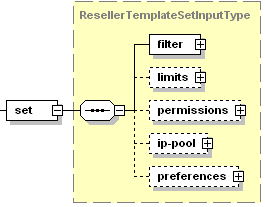
The set node is presented by the ResellerTemplateSetInputType
complex type (reseller_template.xsd). Its graphical representation
is as follows:
Note
The interactive schema navigator for all request packets is available here: http://plesk.github.io/api-schemas/1.6.9.1/agent_input.svg.

The filter node is required. It specifies the filtering rule. Data type: ResellerTemplateFilterType (
reseller_template.xsd). For information on filters, refer to the Available Filters section.The limits node is optional. It specifies limits policy and limits on Plesk resources usage for resellers created with a reseller plan. Data type: resellerLimits (
reseller.xsd). To view structure of this node, refer to the Limits section.The permissions node is optional. It specifies permissions for resellers created with a reseller plan. Data type: clientPerms (
plesk_client.xsd). To view the structure of this node, refer to the Permissions section.The ip-pool node is optional. It specifies IP pool settings for resellers created with a reseller plan. Data type: ResellerTemplateIpPoolType (
reseller_template.xsd). To view the structure of this node, refer to the IP Pool Settings section.
Response Packet Structure
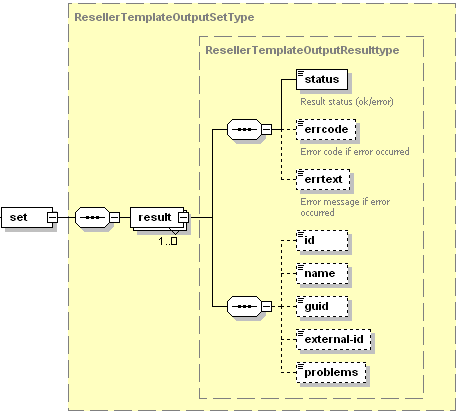
The set node of the response packet is structured as follows:
Note
The interactive schema navigator for all response packets is available here: http://plesk.github.io/api-schemas/1.6.9.1/agent_output.svg.

-
The result node is required. It wraps the response retrieved from the server. Data type: ResellerTemplateOutputResulttype (
reseller_template.xsd).The status node is required. It specifies the execution status of the operation. Data type: result_status (
common.xsd). Allowed values:ok|error.The errcode node is required if the operation fails. It returns the error code. Data type: unsignedInt.
The errtext node is required if the operation fails. It returns the error message. Data type: string.
The id node is required if the request packet filtered plans by IDs and an ID was matched by a filtering rule. It returns name the plan ID. Data type: id_type (
common.xsd).The name node is required if the request packet filtered plans by names and a name was matched by a filtering rule. It returns name the plan GUID. Data type: string.
The guid node is required if the request packet filtered plans by GUIDs and a GUID was matched by a filtering rule. It returns name the plan GUID. Data type: string.
The external-id node is required if the request packet filtered plans by external IDs and an external IDs was matched by a filtering rule. It returns name the plan external ID. Data type: string.
The problems node is optional. It contains the description of problems occurred on the operation execution. Data type: string.
Samples
The following set request packet changes IP pool settings for two reseller plans, one specified by the ID and another by name.
<packet>
    <reseller-plan>
        <set>
            <filter>
                <id>12</id>
            </filter>
            <ip-pool>
                <ip-address>192.0.2.121</ip-address>
                <ip-address>192.0.2.122</ip-address>
                <allocate-ip>2</allocate-ip>
            </ip-pool>
        </set>
        <set>
            <filter>
                <name>base_plan</name>
            </filter>
            <ip-pool>
                <ip-address>192.0.2.121</ip-address>
                <ip-address>192.0.2.122</ip-address>
                <allocate-ip>3</allocate-ip>
            </ip-pool>
        </set>
    </reseller-plan>
</packet>
Response:
<packet>
    <reseller-plan>
        <set>
            <result>
                <status>ok</status>
                <id>81</id>
            </result>
        </set>
    </reseller-plan>
</packet>